This is a Must Read!
Reasons Why We Need Wolves
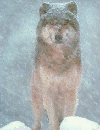
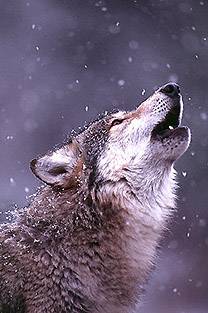
Every few months, my friend Brendan disappears into the wilderness to track wolves. The wolves are tagged with radio collars as part of the Yellowstone Wolf Project, which has been observing the animals in their natural environments in an effort to help protect them since 1995. Brendan’s work as a volunteer is to follow the wolf packs (from a safe distance) and record their behavioral, social, and predation habits. Sometimes he’ll go a day without spotting a wolf, just sitting in sub-freezing snow fields and staring through a scope. Other times, he and his partners will stumble across the juicy meat of the job—a wolf howling atop a boulder, a pack devouring a weakened elk—and the biting, windy wait will all be worth it.
Wolves entered the national limelight this week when Rep. Mike Simpson (R-Idaho) and Sen. Jon Tester (D-Mont.) slipped a measure into the budget deal to strip gray wolves of their Endangered Species Act protections in most of the Northern Rockies—the first time a species has been removed from the list for political reasons, rather than scientific ones. The lawmakers argue that the bill alleviates stress on big-game herds and helps out ranchers and farmers, whose livestock fall victim to the predators. The bill would lift protections for wolves in five Western states and allow wolf hunting to resume in Montana and Idaho. Environmentalists worry that removing wolves from the ESA list could open the doors to allow other endangered species to be delisted as well.
Whether wolves have a negative impact on the Northern Rockies remains a contentious issue. Here’s how Brendan sees it: “Gray wolves and elk have been coexisting for 10,000 years. The problems really stem from people, who are contributing to habitat degradation and forest fire suppression.” Studies show that wolves play vital roles in maintaining healthy ecosystems, and could even help stave off some of the effects of climate change. Scroll through the slideshow to find out how. —Maddie Oatman
Thanks to Defenders of Wildlife and Norman A. Bishop for their help with this slideshow.

Reason #1: Without wolves and other large predators, ecosystems can go haywire. A 2001 study (PDF) found that when wolves went extinct in Yellowstone, for example, the moose population ballooned to five times its normal size and demolished woody vegetation where birds nested. As a result, several bird species were eliminated in the park. Photo courtesy Gary Kramer/US Fish and Wildlife Service

Reason #2: Scavengers thrive when wolves are around. The species that help themselves to wolves’ leftovers include (PDF) ravens, magpies, wolverines, bald eagles, golden eagles, three weasel species, mink, lynx, cougar, grizzly bear, chickadees, masked shrew, great gray owl, and more than 445 species of beetle. Photo courtesy Colby Anton/National Park Service

Reason #3: Wolf kills are also good for the soil. A 2009 study in Michigan’s Isle Royale National Park found that wolf-killed elk carcasses dramatically enhanced levels of nitrogen and other nutrients. Photo courtesy Brendan Oates/National Park Service

Reason #4: Wolf kills feed more animals than hunting by humans, since wolves scatter their carrion over the landscape. Wolf kills benefit (PDF) three times more species than human hunting kills. The carcass above was a bull elk killed by a pack of eight wolves in Agate Creek, Yellowstone. The skeleton was picked clean by wolves and scavengers in less than five days. Photo by Brendan Oates/National Park Service

Reason #5: When wolves disappeared from Yellowstone, coyotes preyed on pronghorn almost to the point of no return. But since wolves have returned, the pronghorn have come back. In fact, pronghorns tend to give birth near wolf dens, since coyotes steer clear of those areas. Photo courtesy Brendan Oates/National Park Service

Reason #6: Deer and elk congregate in smaller groups (PDF) when wolves are around. This helps reduce the transmission of illnesses like Chronic Wasting Disease. Photo of elk in the Blue Range Wolf Recovery Area courtesy the US Fish and Wildlife Service

Reason #7: Chronic Wasting Disease is a major threat to elk and deer in the West. Wolves can help by reducing sick animals’ lifespans, in turn limiting the amount of time they can spread infections. Photo courtesy Colby Anton/National Park Service

Reason #8: Yellowstone elk are less likely to overgraze near rivers and streams—damaging fragile ecosystems—when wolves are in the neighborhood. Photo courtesy the US Fish and Wildlife Service

Reason #9: Wolves help protect against climate change. A 2005 UC Berkeley study in Yellowstone concluded that milder winters, a product of climate change, have led to fewer elk deaths. This left scavengers like coyotes and ravens scrambling for food, but the problem was far less pervasive in areas where wolves were around to hunt elk. Photo courtesy Rich Kirchner/ZUMA Press

Reason #10: Wolf tourism is an economic boon (PDF). Restoration of wolves in Yellowstone has cost about $30 million, but it’s brought in $35.5 million annual net benefit to the area surrounding the park. Photo shows a Yellowstone Wolf Project biologist securing a VHF (very high frequency) tracking collar on a sedated wolf. Photo courtesy Colby Anton/National Park Service
 There is a great deal of evidence supporting the changes in trophic cascades in regard to the presence of wolves in an ecosystem. Introducing a top predator into a top-down ecosystem will have a cascading influence down ecosystem levels. Moose populations are influenced by the number of wolves, and therefore the intensity of wolf predation is evidence that trophic cascades occur in terrestrial ecosystems where top predators are the dominant high level consumers (Estes, 1996). McLaren (1994) studied wolves on Isle Royale and found that during 1988-1991, the wolf population had reached an unprecedented low, which was correlated with moose populations reaching a new high level, accompanied by strong suppression of balsam fir (Abies balsamea) growth. This is a 3-trophic level system dominated by top-down control. Moose (Alces alces) herbivory suppressed foliar biomass and annual wood accrual on the firs (Ripple and Larson, 2000). The growth of trees in this study was determined using tree-ring analysis. This was concluded after observations confirmed that fir growth rates decreased when wolf density decreased, due to an increase in moose density.
 On Isle Royale, balsam fir is 59% of the moose’s diet in winter (McLaren, 1994). Over the course of time, the sensitivity of the balsam fir population to moose numbers became obvious; in 1848 there was 46% abundance of over-story, 1978 it had dropped to 13% over-story, and by 1994 it was down to approximately 5% over-story. On the Island there were other forage species responding to increasing herbivory similar to the response of fir. In neighboring islands where moose numbers were much lower by comparison, there was greater over-story fir growth (McLaren, 1994).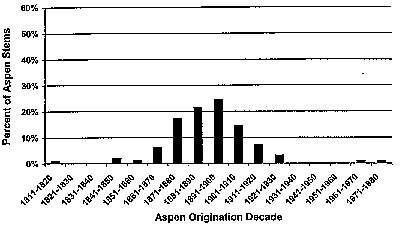
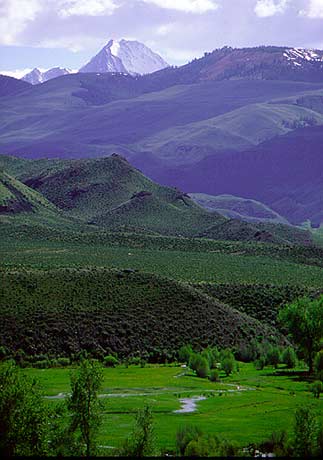 In Mount McKinley National Park, biologists predict that wolves serve to keep the caribou population in check, and without wolves limiting caribou numbers the caribou might populate so extensively that vast areas of lichen range would be severely damaged. Trophic cascades are prevalent in all ecosystems and the importance of which are often only identified after a key element has been removed.