
Wyoming’s anti-scientific laws have allowed the most famous wolf in Yellowstone to be shot. Shooting wolves isn’t only senseless–it actively harms the environment.
Wikimedia Commons
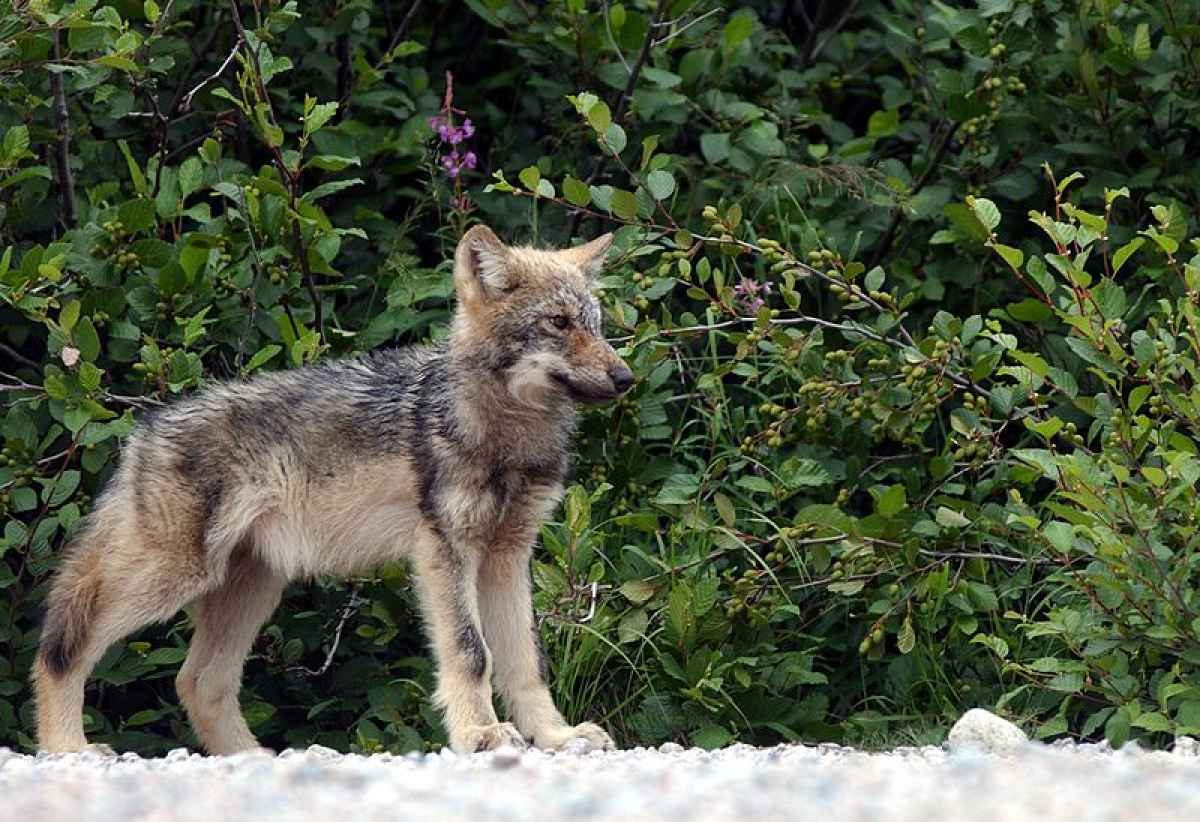
Juvenile Grey Wolf
Last week, an alpha female grey wolf known as 832F, perhaps the most widely seen wolf at Yellowstone National Park, was shot and killed after straying just outside the boundaries of the park and into greater Wyoming. Wyoming is a lunatic state that has legalized the mass shooting of an animal that poses basically no threat to anyone and is, in fact, an essential part of the ecosystem as a whole.
The grey wolf (Canis lupus) was historically found throughout the northern reaches of North America and Eurasia. In North America, it’s still well-spread in Alaska and Canada, despite the best efforts of Alaskans, who like to shoot them from planes. But in the continental United States, it’s had to be reintroduced and protected because state laws have bowed to the ill-informed power of agribusiness and hunters and allowed the wolf to be shot, for no reason, all the time. Yellowstone, just under 3,500 square miles in size, is home to, says the National Park Service, about 98 grey wolves, all protected within the park’s boundary. Wyoming, the aforementioned lunatic state, covers nearly 100,000 square miles, and the state’s absurd legislators have legalized the shooting of any wolf (even right outside the park’s borders, which a wolf wouldn’t recognize as borders because it’s a wolf) so as to keep the total number of grey wolves in Wyoming to 150. Wyoming residents have shot 87 wolves this year, including the alpha female wolf, which spent 95 percent of its time within Yellowstone and made the mistake last week of venturing out into a state that has legalized its murder for no reason.
Earlier this year, under pressure from hunters and agribusiness, the US Fish and Wildlife Service de-listed the grey wolf from Wyoming’s endangered species list–after spending millions of dollars to reintroduce it to its natural habitat after the last time Wyoming residents shot them all. In 1995, wolves were reintroduced into the national parks, and they’re still protected in the parks, but it’s hard to explain the vagaries of national park borders and state and federal law to a wolf, so they tend to stray into the 80% of the state where they can be shot on sight. And wolf populations are still dangerously low in Wyoming. Yes, dangerous: shooting wolves isn’t just useless, it’s actively harmful to the environment.
Here are the reasons proponents of wolf hunting give to keep shooting wolves, and why those reasons are stupid and wrong.
William Campbell/USFWS
Tagged Grey Wolf
Stupid Reason #1. Wolves kill livestock. Well, yeah, sure. In Russia wolves can really damage a watermelon crop (this is true, amazingly) but in North America the grey wolf is so far down on the list of things that can kill livestock as to render this reason completely ridiculous–and, what’s worse, incredibly easy to check. You think you can’t just look up the numbers and see what kills livestock? This isn’t up for debate! This is thoroughly surveyed every year!
In 2010, according to the USDA, wolves killed 8,100 head of cattle, resulting in a total revenue loss of $3,646,000. Whew, lotta money, right? NO IT IS NOT. That’s only 3.7 percent of the total of other predators; coyotes, which are everywhere, account for 53.1 percent, or 116,700 head of cattle. Other animals which kill more cattle than wolves include: dogs (21,800 head), big cats like mountain lions, bobcats, and lynx (18,900 head), and vultures (11,900 head).
And just for the record, we shouldn’t shoot coyotes, either. Coyotes are not technically an invasive species, but they have shown a remarkable ability to adapt to heavily human environments and are certainly a bigger risk to livestock, people, and pets than wolves. In response the US government kills about 90,000 coyotes a year, so there’s no need for you to wander around with a rifle shooting wild animals for fun. And if you live in an area with lots of coyotes, just get a dog. Dogs have been proven to be an extremely effective deterrent for coyotes, which are relatively small canids and are also fairly timid. Get a border collie. That’s a good dog.
Now let’s get into the real embarrassing stats. The idea that carnivorous predators are a major problem for agribusiness is like saying the cost of maintaining movable type is a real problem for the newspaper industry. That’s just not how these things work anymore; if livestock is your business, you’ve got a lot of problems, but wolves aren’t even close to one of them. Remember that wolves killed roughly 8,100 head of cattle in 2010. The USDA’s National Agriculture Statistics Service estimates that 1,055,000 head of cattle were felled by respiratory problems in that same year. Over a million. Digestive problems took out another half a million head. And let’s not pretend the inhumane manner in which agribusiness raises cattle didn’t have something to do with that. Write off another 500,000 each to the weather and various problems with calving. Hell, just flat-out cattle rustling accounted for nearly twice as many lost head of cattle as wolves. Predators are only 5.5 percent of total cattle losses, and wolves are only 0.23 percent of the total. If you’re shooting wolves it’s because you like to shoot wolves, and I hope “gets enjoyment out of shooting majestic creatures” is listed in the next version of the Diagnostic and Statistic Manual of Mental Disorders.